
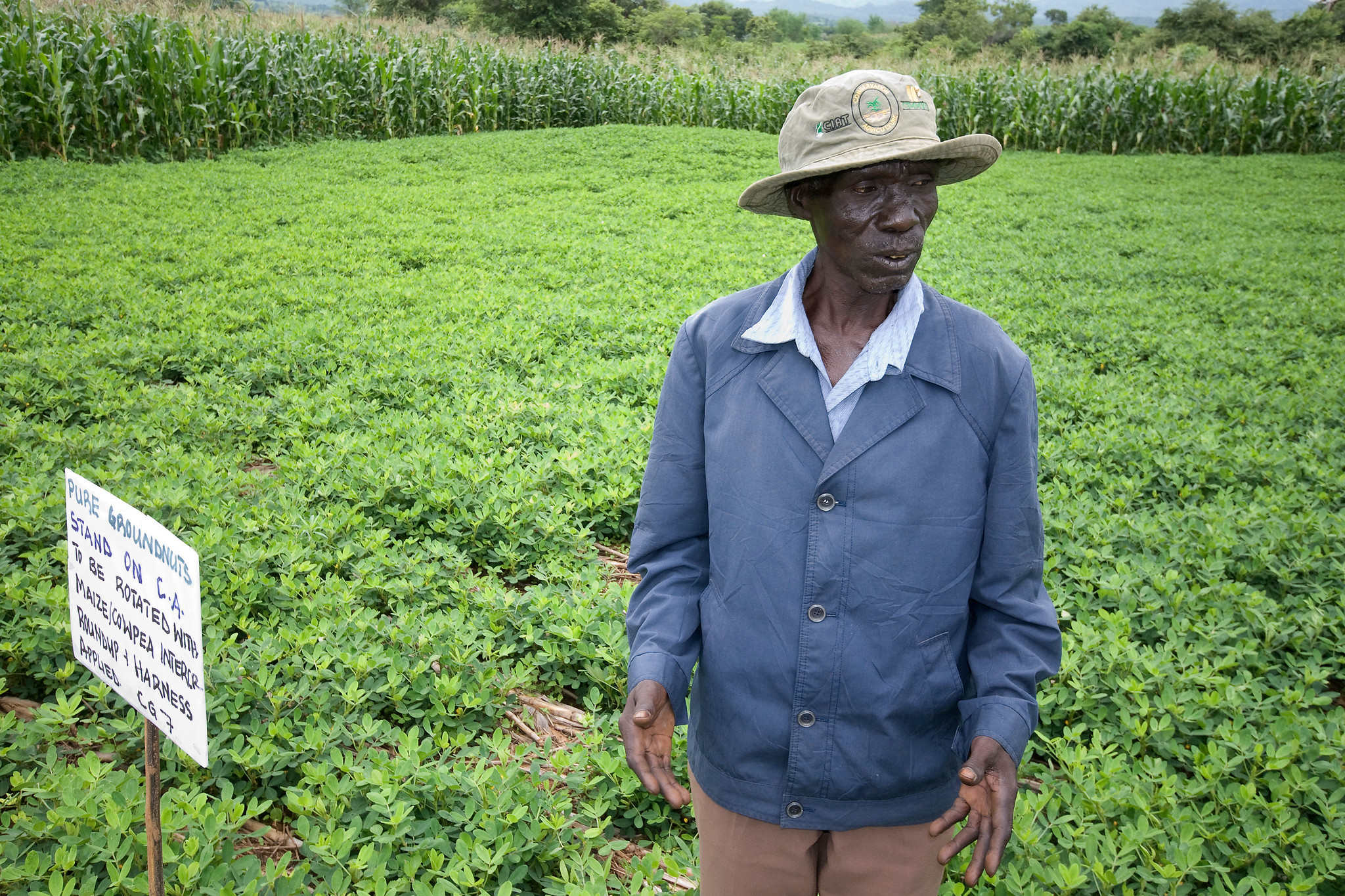
Across Africa, crops like finger millet, amaranth, okra, and sesame have sustained communities for generations. Yet they have been systematically marginalized in research and investment while major staples made steady gains.
By CIMMYT
For decades, the world has fed itself on three crops: maize, rice, and wheat. Together, they account for more than half of all calories consumed globally, and they dominate research budgets, breeding programs, and agricultural policy in equal measure. But this narrow foundation is showing dangerous cracks. Climate variability is making harvests increasingly unpredictable. Soil degradation is accelerating. And hundreds of millions of people, particularly in sub-Saharan Africa, remain chronically undernourished despite living in some of the most agriculturally diverse regions on Earth.
The solution, increasingly, may lie not in doing more of the same. Across Africa, a remarkable array of crops (finger millet, amaranth, okra, pigeon pea, sesame, Bambara groundnut, and taro, among others) have sustained communities for generations. They are drought-tolerant, nutritionally dense, culturally embedded, and economically significant. Okra production in Nigeria alone is valued at over USD 2.4 billion annually. Sub-Saharan Africa produces approximately 21 percent of the world’s pigeon pea, representing a market worth around USD 3.3 billion, one expected to double in value by 2035. Yet these crops have been systematically marginalized in research investment, breeding programs, and policy agendas, leaving their productivity stagnant while major staples have made steady, compounding gains over the same period.
From potential to pipelines
The framework, developed under the Vision for Adapted Crops and Soils (VACS), a global initiative launched by the U.S. Department of State in 2023 and co-hosted by CIMMYT and the Food and Agriculture Organization, identifies seven priority crops and applies what the authors call a “business unusual” approach to their improvement. The term is deliberate. Previous attempts to develop underutilized crops have largely failed because they followed the same short-term, trait-by-trait logic that governs quick-fix agricultural interventions: identify a problem, apply a narrow solution, move on. VACS explicitly rejects this model.
Instead, the approach begins with rigorous prioritization. From an initial pool of roughly 150 candidate crops, a multidisciplinary panel of 80 international experts applied criteria spanning nutritional quality, climate resilience, market feasibility, and economic impact to select the seven crops most likely to deliver large-scale benefit. This was not a romantic exercise in celebrating biodiversity for its own sake, it was a determined assessment of where sustained scientific investment could realistically generate returns for farmers, consumers, and food systems.
The results of that prioritization are significant. All seven selected crops outperform common reference crops on multiple nutritional dimensions, including protein, calcium, iron, zinc, folate, and vitamin A, while demonstrating above-average tolerance to drought and heat stress. They are, in other words, precisely the kinds of crops that a warming, nutritionally stressed world needs more of.
The science of closing the gap
The central challenge is not identifying these crops’ potential that has been known for years. It is translating potential into measurable, scalable genetic gains. Here, the VACS framework draws directly on decades of innovation in major crop breeding, adapting tools and methodologies that have driven yield improvements in maize, rice, and wheat for use in opportunity crop programs.
One of the most striking findings concerns the power of modernized breeding pipelines. Current breeding programs for crops like finger millet are characterized by long recycling times, small population sizes, and limited use of genomic tools, all of which constrain the rate at which genetic improvement can occur. Simulation modeling conducted under VACS shows that optimized regional pipelines incorporating genomic selection could deliver five times greater genetic gain in the first five years compared to current approaches.
Genomic selection (the use of genome-wide molecular markers to predict the performance of breeding lines before they are field-tested) is already standard practice in major crop programs. VACS is now deploying it for opportunity crops, alongside rapid generation advance techniques that compress breeding cycles, AI-powered image-based phenotyping tools trained on over one million field images, and the Enterprise Breeding System, an open-source informatics platform that integrates germplasm management, trial design, and analytics into a single workflow. In parallel, genome sequencing efforts are accelerating. A reference-quality chromosome-resolved genome assembly for finger millet was recently published, and the VACS team has sequenced the popular variety U15, widely grown in Tanzania, Malawi, Kenya, and Uganda, to serve as a reference genome, with a pangenome for the crop now under development.
Markets first, science second
What distinguishes the VACS approach from previous efforts is its insistence on market intelligence as the starting point for breeding investment, not an afterthought. Before a single cross is made, country-level Product Design Teams, bringing together researchers, seed companies, processors, policymakers, and farmers, convene to identify which market segments justify breeding effort and what specific traits improved varieties must deliver to succeed in those markets.

Across the seven crops, more than 20 country-level Product Design Teams have met, identifying 46 market segments, of which 20 have been prioritized based on evidence of demand. For sesame in Tanzania, this process produced a Target Product Profile for white early-maturity sesame, the country’s largest market segment, covering an estimated 1.3 million hectares, specifying five traits essential for varietal acceptance and ten additional attributes that would enhance market value. This kind of precision is what separates a breeding program with a realistic path to adoption from one that produces varieties farmers never plant.
The seed systems dimension is equally important. VACS operates through a Public-Private-Producer Partnership model that links public research institutions, private seed companies, and organized farmer groups to ensure that improved varieties actually reach the fields where they are needed. In Kenya, Tanzania, Ghana, Senegal, Malawi, and Zambia, early results show that when improved seed, agronomic knowledge, and market access converge, adoption can scale rapidly, particularly when women and youth are positioned as seed producers, traders, and village-based advisors.
Investing in the scientists of tomorrow
No crop improvement program is more durable than the human capital that sustains it. VACS has embedded 28 graduate scholars, ten at master’s level and eighteen pursuing doctorates, within its breeding teams, conducting thesis research on the most pressing knowledge gaps across the seven crops. They are nationals of eight countries, registered in 16 African universities, and working on everything from genomic tools for shattering resistance in sesame and Striga resistance in finger millet, to gene editing applications and drone-based phenotyping for okra. The goal is not only to solve today’s problems but to build the African scientific community that will continue this work long after any single project ends.
A different kind of ambition
The ambition of VACS is not to replace maize, wheat, and rice. Billions of people depend on these crops and will continue to do so. The goal is to expand the range of options available to farmers and consumers to build a food system with more diversity, more resilience, and more capacity to nourish people across the full range of environments and circumstances that characterize life in Africa and beyond.
The science to do this exists. The tools are increasingly available. What has been missing, until now, is the sustained, coordinated, market-oriented investment that major crops have always enjoyed. VACS represents a serious attempt to provide exactly that, and its early results suggest that Africa’s forgotten crops may be ready, at last, to step out of the shadows.
This article is based on research published in Nature Communications (Vol. 17, Article No. 2872, March 24, 2026): “Steps to transform African opportunity crops into reality crops” by Rutsaert, Pixley, and colleagues from CIMMYT and partner institutions.