
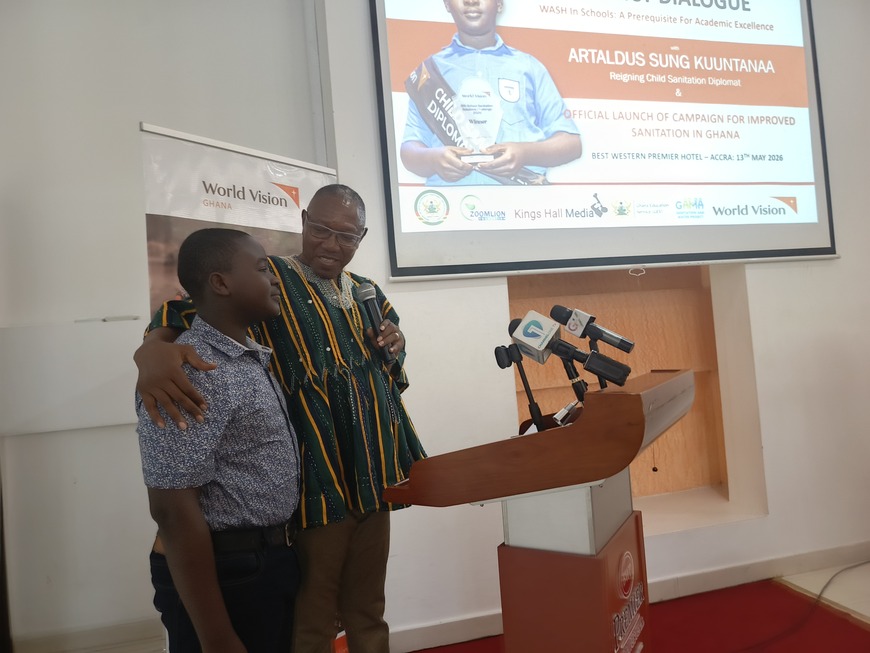
The government of Ghana pledged on Wednesday to ensure that all new school structures to be built in the country have adequate water, sanitation, and hygiene facilities.
Deputy Education Minister Clement Apaak said during the WASH-in-Schools policy dialogue and launch of the 6TH Child Sanitation Diplomat’s one-year project that a conducive learning environment goes beyond classrooms, textbooks, laptops, and qualified teachers but also includes access to clean drinking water, decent toilet facilities, and proper hygiene services.
Apaak regretted that many schools across the country, especially public basic schools, continue to face serious challenges in access to water, sanitation, and hygiene (WASH) facilities. “This situation affects not only the health of learners but also their dignity, attendance, and academic performance.”
The deputy education minister attributed the phenomenon to the construction of school facilities in the past without provision for proper WASH facilities, adding that the government has decided to change the situation henceforth to align with the UN standards for safe learning environments.
“I wish to assure you that under the leadership of President John Dramani Mahama and the visionary direction of the Minister for Education, Hon. Haruna Iddrisu, no new school infrastructure project will be undertaken without the full provision of water, sanitation, and hygiene facilities,” Apaak announced.
He said the government would work through ministries, departments, agencies, local government assemblies, and development partners to continue ensuring that every school has access to clean drinking water, decent toilet facilities, and proper hygiene services.
The policy dialogue was organized in partnership with World Vision International, a global charity, under the theme “WASH in Schools: A Prerequisite for Academic Excellence,” with representatives from educational sector stakeholders, government, and local government agencies, as well as development partners participating.
Apaak commended World Vision Ghana for its continued support to the education sector, particularly in infrastructure development, teaching and learning materials, and capacity-building programmes.
Mercy Nuleyan, Director for Finance at World Vision Ghana, emphasized collective action from government, development partners, private sector, civil society organisations, and communities to ensure that schools have adequate WASH facilities.
According to Nuieyan, the campaign focuses on children because children could be powerful agents of change when properly empowered and supported.
The 6th Child Sanitation Diplomat Artaldus Sung Kuuntanaa of the Accra College of Education Demonstration School, launched his annual campaign, urging stakeholders to support him send the message of change nationwide.
The 2020 Education Management Information System (EMIS) report indicated that 25 percent of public basic schools in Ghana lack safe drinking water, while 26 percent lack improved toilet facilities.
The EMIS report added that 11 percent of private basic schools lack safe drinking water on their premises, while 17 percent lack adequate toilet facilities, with a combined effect on more than 1.5 million pupils in public schools and over 314,000 pupils in private schools.