
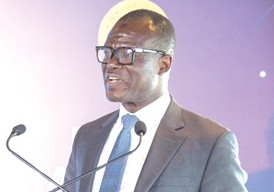
Ghana’s central bank has adopted Artificial Intelligence (AI) and big data technologies to aid policy formulation and decision-making, First Deputy Governor Zakari Mumuni disclosed on Wednesday.
Mumuni said during the 4th Annual Statistics and Data Science Conference, in Tamale, the capital of Ghana’s Northern Region, that the new technology would aid the Bank of Ghana in the development of its in-house electronic inflation (e-inflation) nowcasting methodology.
“We also employ machine-learning models to complement standard econometric models in forecasting GDP and performing text-mining analytics,” the deputy governor disclosed, adding that the bank also employs technology to accelerate the work of banking supervision.
According to him, this approach is in line with the pledge of Bank of Ghana Governor Johnson Asiama in in Feb. 2025 that the central bank would adopt a more proactive and precise approach to managing inflation, “leveraging advanced data analytics and artificial intelligence.”
The deputy governor said the Bank continues to strengthen its capacity in artificial intelligence, data analytics, and virtual assets.
He added, “Technology is essential, particularly in closing the gap between when something happens and when a policymaker knows about it. It can mean catching a problem while it is still small rather than discovering it after it has grown.”
“But as technology becomes more sophisticated, one principle must remain clear: Technology can strengthen our intelligence, but it does not remove the need for human judgment,” Mumuni cautioned, adding; “After all, people make policy.”
He urged Ghanaian institutions to invest in quality data because everything else depends on it; embrace high-frequency and alternative data without abandoning statistical standards. “New data should complement—not replace—properly weighted and nationally representative measures.”
“The future we should want is not one in which machines make our decisions for us. It is one in which better data guides better policymaking,” the deputy governor highlighted. Enditem