
A Rotary-backed skills centre in Ghana’s Shai Osu-Doku District is quietly building the kind of grassroots economic model that governments, private investors, and international development partners have been searching for, and at its heart is a woman who refused to let a dream die.
The Dream That Waited Four Years
In 2021, a Ghanaian community development leader named Anne Ethel Komlaga sent a message on LinkedIn in response to a simple Rotary request. On the other end was Kate Noel of the Rotary Club of Bay City, Michigan. Neither of them could have known that a single online exchange would grow, over four patient years of planning, into a US$30,000 Rotary Foundation Global Grant and a fully equipped Skills and Enterprise Development Centre in the rural community of Doryumu, in Ghana’s Greater Accra region.
That vision has now become reality. And in June 2026, the first cohort of trainees graduated, a milestone that speaks less about ribbon-cuttings and more about what happens when international goodwill meets disciplined local execution.
A Partnership Built Across Continents
The Doryumu project is the product of a carefully assembled coalition, each partner bringing something the others could not:

Rotary Club of Bay City, Michigan (USA), International Sponsor, whose members, led by Foundation Global Grant Chair and Past-President Andreas Teich and long-time champion Kate Noel, carried the grant through The Rotary Foundation’s rigorous approval process.
On its part, Rotary Club of Akosombo Dam-City (Ghana), Host Club, chartered only in June 2022, punching well above its weight under the guidance of Assistant Governor Joseph Dzamesi, who has framed the project’s sustainability requirements from day one.
As the implementing partner, Quantum Ideas Ghana, led by Anne Ethel Komlaga, provided on-the-ground programme design, trainer recruitment and community engagement.

The Traditional Authorities of Doryumu, co-implementers and gatekeepers of legitimacy, including Nene Teye Djaba, Jjassey of Doryumu, and Nene Afedi, Katamanso Yelagbeye, 1 Sinpim of Doryumu, whose stewardship has grounded the initiative in local ownership.
“In Rotary, one of the most important aspects is sustainability,” AG Joseph Dzamesi repeatedly stressed. “We don’t put money into any p
roject that cannot be sustained.” That principle now sits at the centre of every decision in Doryumu.
What US$30,000 Actually Looks Like on the Ground
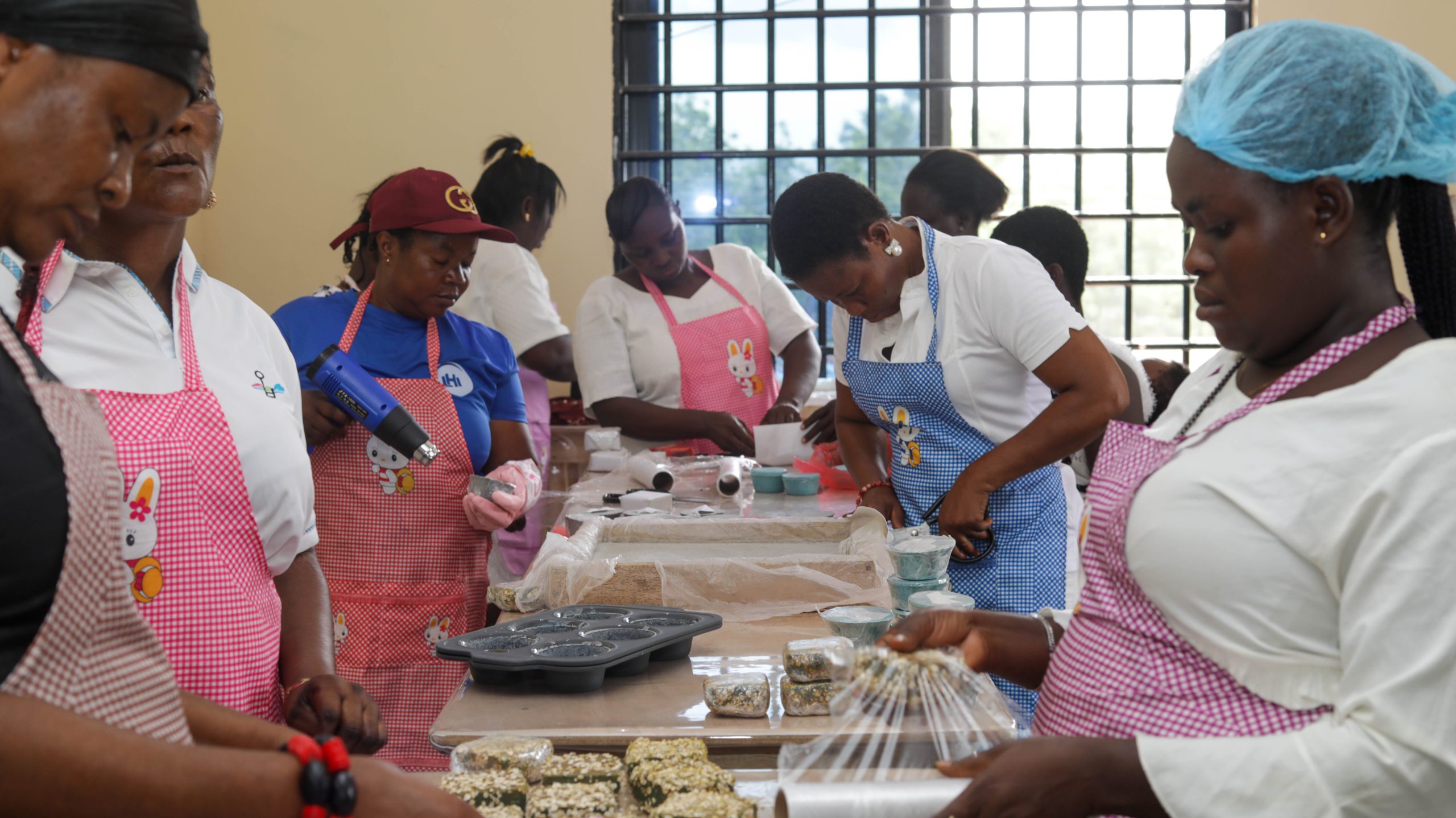
The grant has already delivered tangible hardware and human results. The centre is anchored by a 200-litre industrial mixer capable of blending liquid soap, bath gel and bar soap, complemented by custom moulds and cutters engineered for mass production, a deliberate leap from cottage-scale demonstration to real enterprise readiness.
But the more revealing numbers come from the graduation report of the first cohort: Out of more than 50 community members who enrolled on day one of training, 24 completed the intensive six-day programme and received their certificates of competence.
Approximately US$1,500 was raised at the closing exhibition, where products made by the trainees were purchased on the spot, much of it by the traditional authorities, sending a powerful signal of local market validation.
That final figure matters more than it looks. A community exhibition that generates real cash sales on graduation day is, in development terms, a live proof-of-concept: the product is desirable, the price point works, and the graduates are ready to trade.

The Quiet Architect
Anne Ethel Komlaga is the kind of leader who turns bold ideas into steady, visible progress. She works with ambitious founders, community organisers and cross-border teams to convert big vision into consistent execution, and Doryumu is that discipline made tangible in mixers, moulds and margins.
Her work sits at the intersection of leadership development and community transformation. She listens before she plans, plans before she promises, and delivers before she claims credit. Colleagues describe her as equally at home in a boardroom negotiating grant compliance, in a Rotary chamber shaping strategy, and in a palace courtyard seeking the blessing of traditional authorities. She built the bridge between Bay City and Doryumu one conversation, one field visit and one carefully kept commitment at a time.
Her own remark at the centre’s opening captures her posture. “This is a dream that began so many years ago,” she said. “We need equipment that will help us do mass production.” Not a plea. A plan.
Why This Project Should Matter
For anyone thinking seriously about the future of Africa’s rural economies, Doryumu is not just a heart-warming story. It is a working model.
It creates real jobs where they are needed most. Rural Ghana loses too many of its young people to cities that are not ready to absorb them. A vocational centre that can put certificates, skills and starter income into the hands of two dozen young women and men in a single cohort is a direct answer to that drift.
It builds enterprises, not dependency. The equipment installed in Doryumu was chosen for one reason: to move graduates beyond survival production into small-batch manufacturing that can supply shops, hotels, schools and district markets. Every certificate handed out is a potential microenterprise, a potential employer, and a potential taxpayer.

It strengthens homes and stabilises the community. When young people earn, households eat better, children stay in school, and the pressures that push families toward crisis lose their grip. Nene Teye Djaba puts it plainly: “If they have their own skills and are earning money, nobody can lure them into early pregnancy.”
It is a replicable blueprint for community development. A modest grant, disciplined governance, a credible local implementer, and the full backing of traditional authority. Combined, they produce results that far larger interventions often fail to deliver. Doryumu is a template that can travel, village by village, district by district.
What Comes Next, and How You Can Join
The team is preparing to launch the second cohort without delay, and to widen the training beyond soap and bath-gel production into adjacent product lines and, crucially, into packaging, branding and market access, the classic bottleneck that separates a certificated graduate from a paying entrepreneur.
This is where the story opens up. Doryumu is not a closed circle. It is an invitation.
To government and district authorities, from the Shai Osu-Doku District Assembly to the Ministry of Trade and the Ghana Enterprises Agency: formalise, integrate and scale. Bring the graduates into national MSME pipelines and let this centre become one of many.

To corporate Ghana and the private sector: adopt a cohort. Sponsor packaging, labelling or working capital. Offer offtake agreements for the soap, gel and bar-soap lines coming off the centre’s mixers. Every carton bought is a household stabilised.
To philanthropists and diaspora networks: the Rotary Foundation Global Grant has done its part. The next mile, expansion into new product lines, permanent tools, working capital for graduating enterprises, needs new hands on the wheel.
To international development partners and agencies: here is a small-footprint, Rotary-audited, community-endorsed pilot that is ready for co-financing, evaluation and replication across other rural Ghanaian communities.
To the media, researchers and fellow community leaders: come and see. Document, learn, borrow the model, and carry it home.

The Bigger Story
Doryumu is, on paper, one training centre in one village. But look closer and it is something more interesting: a working demonstration that a US$30,000 grant, routed through disciplined Rotary governance, activated by a Ghanaian social enterprise, sanctioned by traditional authority, and led by someone patient enough to build trust across an ocean, can produce 24 certified entrepreneurs, US$1,500 in first-day sales, and a locally governed institution ready to keep going, with a new Rotary Community Corps (RCC) already formed in Doryumu to steward the centre for the long haul.
That is not a charity story. It is a blueprint. And its principal architect, whether or not she would ever say so publicly, is Anne Ethel Komlaga.