
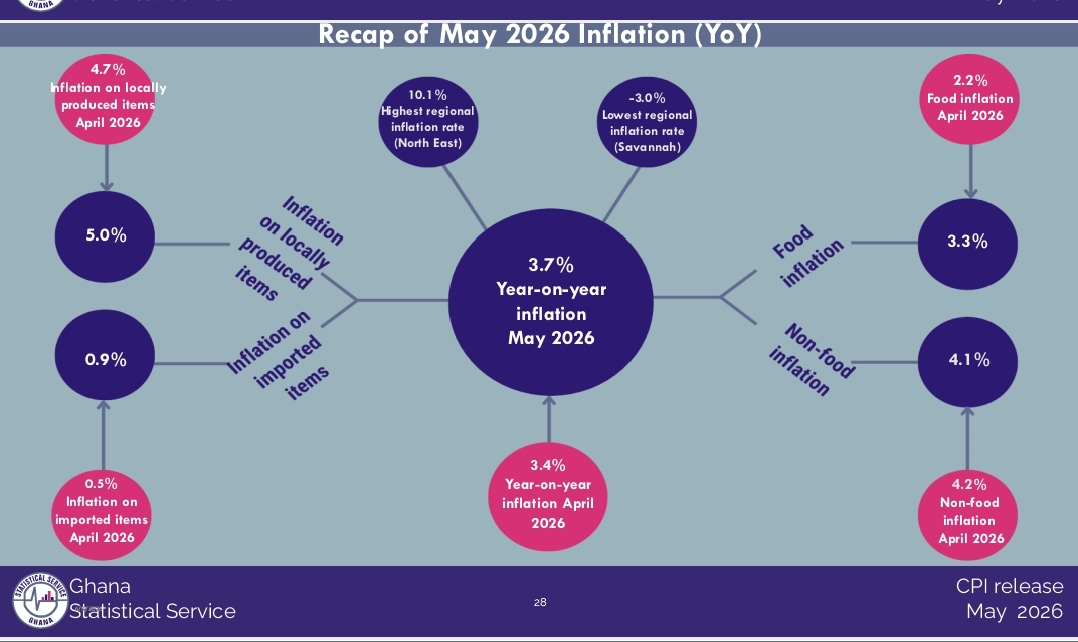
Ghana’s consumer inflation rate increased to 3.7 percent year on year in May, marking a 0.3 percentage point increase over the 3.4 percent recorded in April, the Ghana Statistical Service (GSS) said on Wednesday.
The increase in May marked the second rise in inflation over the past 16 months, since December 2024, when it stood at 23.8 percent.
Government Statistician at GSS, Alhassan Iddrisu, said during the monthly release in Accra, the Ghanaian capital, that the increase in headline inflation in May was mainly due to a rise in food inflation.
“The food inflation rate recorded a year-on-year surge of 3.3 percent in May, from 2.2 percent in April, and the non-food group recorded a year-on-year inflation rate of 4.1 percent in May compared with 4.2 percent the previous month,” Iddrisu stated.
Meanwhile, inflation for locally produced and imported items stood at 5.0 percent and 0.9 percent in April, compared with 4.7 percent and 0.5 percent, respectively, in April.
During the Monetary Policy Committee (MPC) press conference in May, Bank of Ghana Governor Johnson Asiama projected that inflation is expected to trend upward into the medium-term target band from 6.0 percent to 10 percent by the end of 2026 largely due to base drift effects related to exchange rate movements, food supply conditions, and transport fares.
“Upside risks to the inflation outlook include the protracted Middle East crises, which could keep crude oil prices above 100 U.S. dollars per barrel and raise the prospect of petroleum price pass-through to domestic transport and utility costs,” Asiama stated.
The MPC, therefore, decided to maintain its benchmark policy rate at 14 percent after a six-month cycle of reductions, as it assessed risks in the outlook to inflation and growth as broadly balanced.