
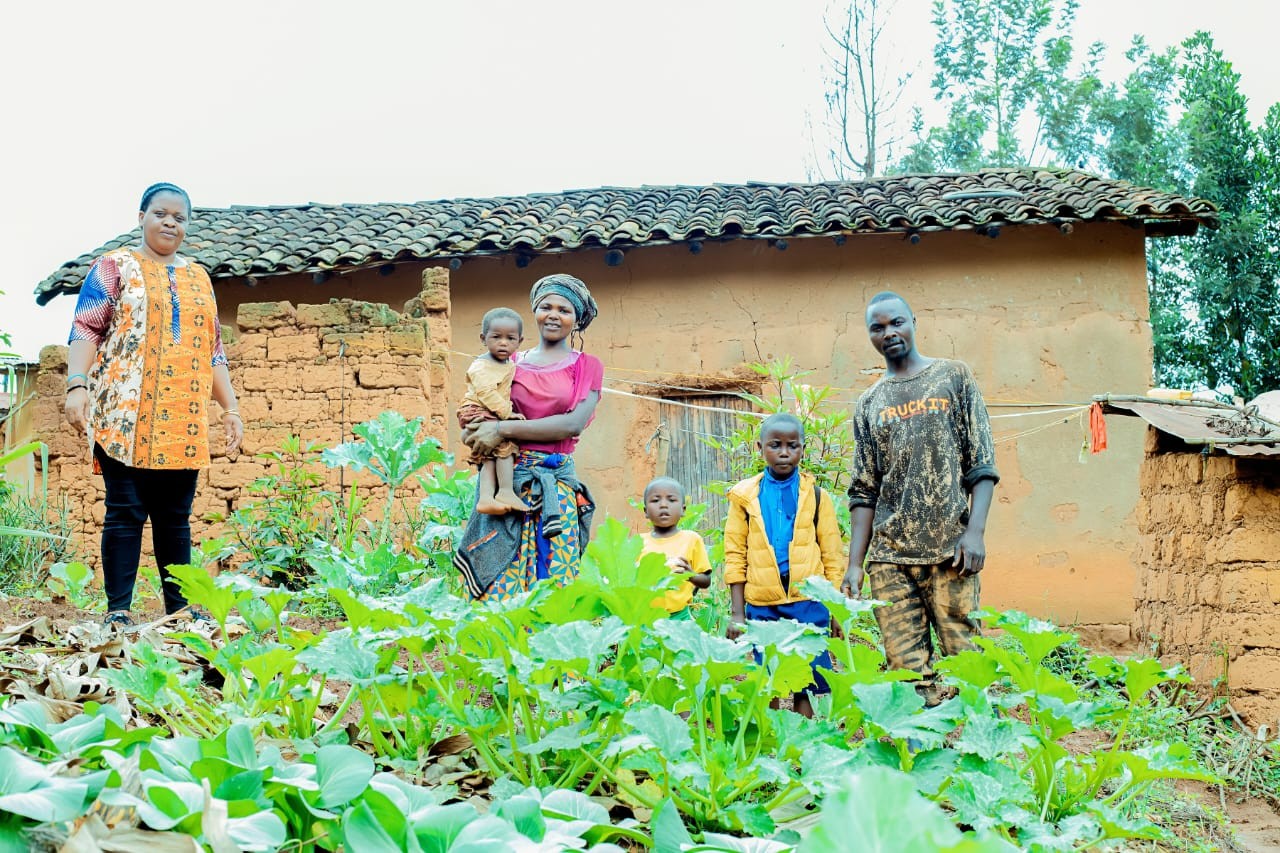
In Musenyi Village in Rwanda’s Northern Province, the ground tells two stories. Beyond the neat rows of vegetables, the memory of failed rains lingers. Nevertheless, 32-year-old Innocent Ntibarikure, a father of three, and his family expect bountiful harvests from their Permagarden. While other plots struggled this season, their Permagarden has continued to produce.
“By applying techniques I learned from The Permagardens Foundation, I’ve been able to cultivate cabbage, cucumber, courgette and pear,” he said, standing beside rows that stayed green even when the June–September rains failed.
For a household dependent on the land, the harvest means food within reach and greater control over what reaches the cooking pot. Ntibarikure also runs a compost site, turning organic waste into fertilizer instead of letting it rot and release methane. He teaches other families to use the same methods in their backyards, so less waste goes to waste, and more nutrients go back into the soil.
El Niño, a natural climate pattern linked to Pacific Ocean temperatures, can influence rainfall far beyond the Pacific, but its effects are not uniform. Across East Africa, rainfall shifts vary by location and season. Not every drought or flood can be attributed to El Niño, which makes preparation essential.
The World Meteorological Organization reported in August 2026 that El Niño was developing and expected to strengthen, with wetter-than-usual conditions forecast for much of the Greater Horn of Africa in the final quarter of the year. The outlook included western Rwanda and parts of the Lake Victoria Basin, where heavy rainfall could improve water supplies but also increase the risk of floods, crop losses and disrupted livelihoods.
Too much rain can be as damaging as too little. Downpours can wash away topsoil, drown roots and destroy young crops. A garden that retains moisture while allowing excess water to drain is therefore not only a drought response. It is an attempt to manage both extremes.
Healthy Soil Holds Precious Water

Banana leaves and straw cover the soil to hold moisture. Photo Credit: The Permagardens Foundation
In Ntibarikure’s garden, the answer begins below the leaves. Mulch covers the soil, reducing evaporation and shielding it from direct heat. Wood ash adds organic matter that can improve soil structure and help the soil retain moisture. Different crops are grown together, spreading risk instead of relying on a single harvest.
These practices cannot make a garden immune to extreme weather. They improve growing conditions and give families more options when rainfall becomes unreliable. The approach combines soil care, crop diversity and household food production in a compact space.
A 2023 review in Nature Reviews Earth & Environment identifies the El Niño-Southern Oscillation and Indian Ocean Dipole as “dominant influence[s] on inter-annual variability” in eastern Africa’s rainfall. It links that variability to risks for food systems and calls for investment in adaptation and early warnings.
Households Measure Their Food Security
The work in Musenyi has also begun to spread beyond one household. Christine Mukeshimana, a member of The Permagardens Foundation’s Practitioner Circle in Gakenke District, says more than 60 Permagardens have been cultivated since July 2025.
“We cannot control the rain, but we can change how we prepare for it,” she said. “In Musenyi, we are not just growing vegetables. We are growing hope, one Permagarden at a time.”
A 2026 post-gardening survey of 40 families in Gakenke found that 99 percent said vegetables were available or highly available, 95 percent were not worried at all about a lack of food, and 86 percent could still grow and harvest during the dry season. Peter Otiende, Director of Global Initiatives at The Permagardens Foundation, who compiled the survey, said the results point beyond the harvest.
“What we are seeing is not just more food,” he said. “Families are able to pay school fees, buy grains, and women are training others. Permagardens are building sovereignty at the household level.”

Post-Permagardening Survey 2026: Gakenke District, Northern Rwanda, n = 40
Ugandan Gardens Face Sudden Floods

A new seedling goes into the ground as the community looks on. Photo Credit: The Permagardens Foundation
From Rwanda’s hills, the story continues in central Uganda, where the challenge has arrived in a different form.
In mid-June 2026, drought had turned Kireeku Village brown. Dry winds crossed the community, and little remained green. For Mama Cathy, an elder, the conditions recalled the hardest period she could remember since childhood.
“Oh, help us Lord,” she lamented, sitting in front of her house, worried.
Then, one Sunday morning, the sky darkened. Rain fell for six hours. In the days that followed, clouds returned almost every afternoon. The downpour flooded gardens, and crops began to turn yellow. The shift from dry ground to waterlogged plots exposed another weakness in food production: a garden that cannot cope with excess water can lose its harvest just as quickly as one starved of rain.
The Kireeku Mothers Permagarden Foundation group recently received training. Its vegetable beds remained green while nearby gardens struggled. Maria Nakato, one of the group’s members, says she now harvests three times more from her Permagarden than her neighbors.
“Oh! Look at my vegetable garden. El Niño is not a problem. Prepare the soil and the rain becomes food,” she told her neighbors. “Manure in the Permagardens acts like a sponge. It holds water and feeds the plants slowly. That is why we have no waterlogging and no root rot.”
Her words reflect the confidence of seeing a difference in the garden. Still, compost and organic matter support soil structure and moisture retention; drainage, soil type, slope and rainfall intensity also affect waterlogging. No single technique can prevent every form of flood damage.
Knowledge Spreads Beyond Training Plots

Red-stemmed amaranth in the garden ahead of harvest. Photo Credit: The Permagardens Foundation
Yosswa Lutaaya, a Permagarden Practitioner in Mityana, has watched the Kireeku group expand.
“We have made it 100% this time,” he said. “We now have more than 30 gardens planted. Mothers are training each other, and people keep asking when the next training is for Permagardening.”
Peer learning matters because adaptation depends not only on garden design but also on access to practical knowledge, materials and continued support. When practitioners teach neighbors, methods can spread and be adjusted to local conditions.
The World Meteorological Organization said the 2023 El Niño and positive Indian Ocean Dipole “played major roles in rainfall patterns” across Africa. Its report documented extreme rainfall and flooding in East Africa in 2023 and early 2024, damaging crops and infrastructure and affecting hundreds of thousands of people. This shows that food security depends not only on how much rain falls, but also on when and how intensely it arrives.
During heavy rains, the Permagardens rely on berms. The berms protect the plots and channel water underneath the double-dug gardens instead of washing through them. It is this feature that helps the system hold up in flood conditions.
The experiences in Musenyi and Kireeku do not establish that one model can address the region’s food challenges. The number of gardens, harvest durability, maintenance costs, and performance across multiple seasons require monitoring.
Families report growing vegetables, making compost, and teaching neighbors. Whether the gardens keep producing, and whether more households can adopt the practices, will depend on available land, water, and support.
Featured Image: Vegetables growing beside the home provide food for the family. Photo Credit: The Permagardens
The writer is a science journalist.
E-mail: prissyof@yahoo.com