
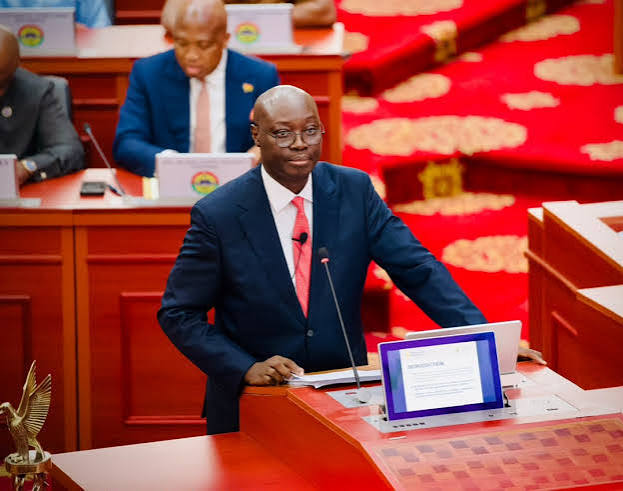
From January 2027, Ghana will shift the focus of its economy toward strong domestic production capacity to transform Ghana into a modern manufacturing-backed economy, Finance Minister Cassiel Ato Forson told parliament during the presentation of the 2027 budget late Thursday.
According to Forson, the 10-billion-dollar new economy program to run from 2027 to 2030 is aimed at creating a modern economy for jobs and prosperity, adding, “Ghana’s next phase of growth must be investment-led, export-capable, and job-intensive.”
This proposed new economy, according to the finance minister, is based on eight pillars, including macroeconomic stability and affordable finance; commercial agriculture; energy infrastructure; critical minerals value addition; tourism, culture, and creative arts; textiles and garments; pharmaceuticals and biomanufacturing; and the technology economy.
As part of the new economy, the minister said Ghana would invest 1.5 billion U.S. dollars to build an industrial mineral economy around manganese, bauxite, lithium, and gold to improve mineral value retention locally, improve export earnings per ton, create skilled jobs creation, and create jobs for Ghanaian suppliers.
Under this program, Forson said the government targets to ensure that at least 70 percent of artisanal and small-scale gold will be refined locally by December 2027 and 100 percent by Dec. 2028, as the government bans the raw export of artisanal gold by
Moreover, he said the government aims to achieve 50 percent local preprocessing of Ghana’s manganese and bauxite by the end of 2028 and “by the end of 2030.”
In that same vein, he said the country would commence its lithium development with local refining, moving progressively into battery-grade chemicals, components, and cells. The country plans to build a 24-hour minerals processing enclave in the Western Region.
“We must move our minerals toward greater value and our people toward greater prosperity,” the minister emphasized.
Planned deliberate and well-targeted investments in modernizing agroprocessing, textiles and garments manufacturing, pharmaceuticals and biomanufacturing, and investments in developing the technology sector are all part of the proposed new economy.
To support industrialization, the minister said Ghana would invest 2.2 billion dollars in energy infrastructure, including preparatory work for institutional and technical capacity to for an enabling environment to include nuclear in the country’s energy mix, “as industrialization cannot advance without reliable and affordable power.”
Part of the financing for the new economy, Forson said, would come from reducing the county’s primary surplus by one percentage point of GDP and an increase of 0.5 percent of GDP in tax revenue.
The West African country completed its 36-month reforms backed by a 3-billion-dollar loan from the International Monetary Fund last May with inflation which had peaked at 54.1 percent in Dec. 2022, running at 5.5 percent in Oct. 2026.