
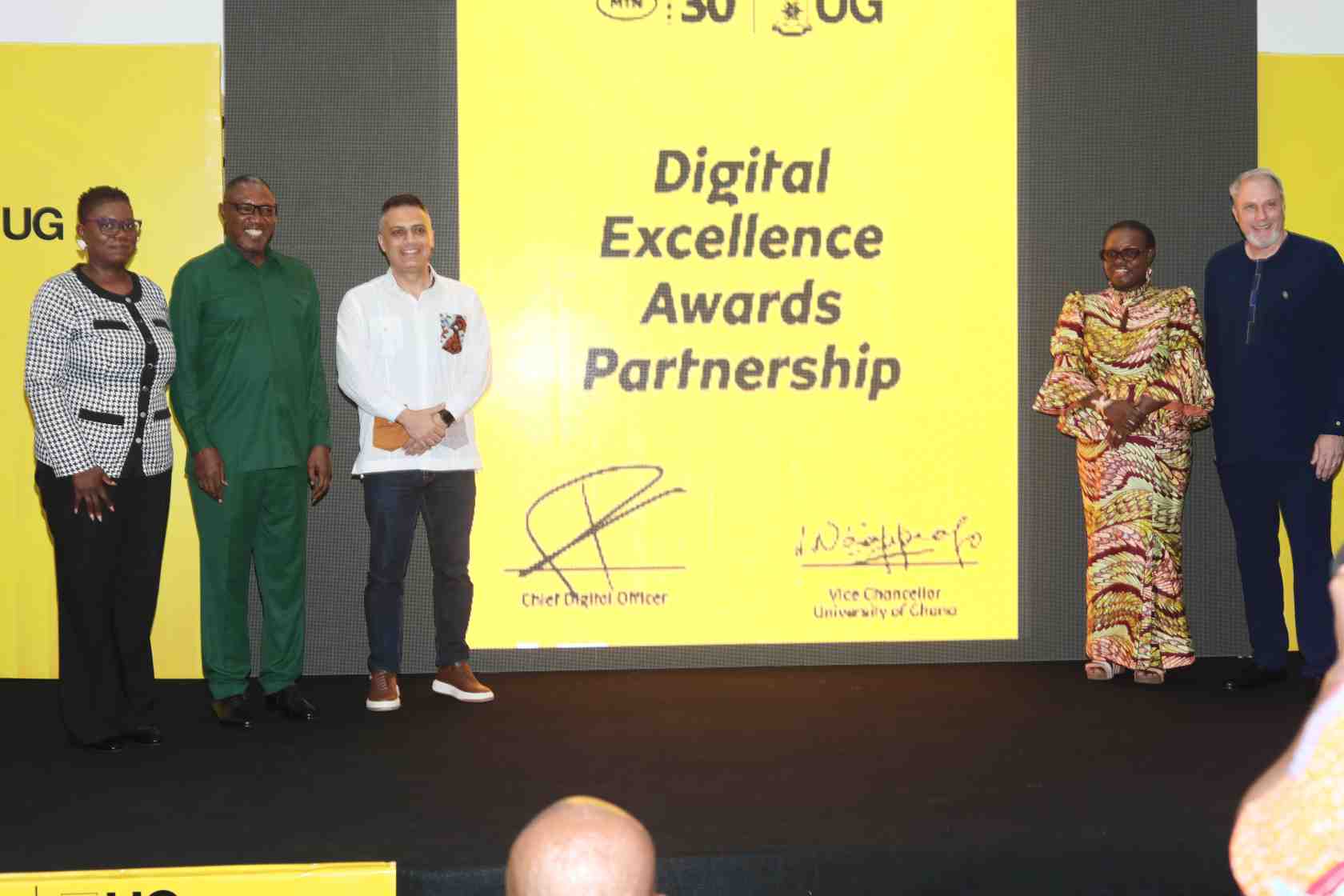
Computer science students at the University of Ghana will soon be able to take an idea from a lecture hall to a working product, after MTN Ghana and the University of Ghana (UG) signed a Memorandum of Understanding (MoU) to build the country’s digital talent pipeline through the MTN Ghana Digital Excellence Awards and the Tɛkyerɛma Pa AI Hackathon.
Signed at MTN House in Accra, the agreement closes the long-standing gap between what students learn and what industry needs. It gives them access to real business problems, industry mentors and the technology to build answers, with the strongest ideas backed to move from prototype to deployment.
Chief Executive Officer of MTN Ghana, Stephen Blewett, said the partnership was about making sure Ghana’s best young minds have somewhere to take their ideas, and that the solutions powering the country’s digital economy are built at home.
“This meeting together now is a step forward in strengthening the bridge between academia and industry to support the growth of Ghana’s digital future,” he said.
Mr Blewett said the talent already exists in Ghana’s lecture halls; what has been missing is the bridge to industry. Too many promising ideas, he noted, end as a final-year project instead of a product.
He said the Tɛkyɛrɛma Pa AI Hackathon would put students to work on live business and social challenges, giving them the kind of experience that shapes careers and, in some cases, starts companies.
“I like hackathons because a hackathon brings theory to practice. That is the principle of a hackathon – we have a problem, we need to find a solution,” he said.
He added that MTN Ghana’s commitment would not stop at the pitch. Winning teams will be taken through mentorship, incubation and piloting, with the strongest solutions considered for deployment on MTN’s network — reaching customers rather than sitting on a shelf.
Chief Digital Officer of MTN Ghana, Ibrahim Misto, said the stakes for young Ghanaians in the AI era were too high for them to sit on the sidelines. “Today we are making a clear statement that Ghana’s young people must not simply consume the AI revolution; they must help build it, shape it, and lead it,” he said.
The Tɛkyɛrɛma Pa Hackathon will challenge participants to solve problems Ghanaians face every day, and to build for users who are often designed out — including those in local languages and in underserved communities.
Mr Misto said the ambition was to raise a generation of Ghanaian problem-solvers whose work is relevant at home, scalable across Africa and competitive anywhere in the world.
Vice Chancellor of the University of Ghana, Professor Nana Aba Appiah Amfo, said the partnership would give students something a curriculum on its own cannot: exposure to how technology is built, sold and scaled in a live commercial environment.
In practical terms, she said, it opens doors — internships, national service placements, industry visits, masterclasses, joint research and innovation challenges — that improve a graduate’s chances of walking into a job rather than a queue.
Prof. Amfo said the partnership should be judged not by the ceremony but by what it produces: students placed, research completed and innovations that make it into the market.
Deputy Minister for Education, Dr. Clement Abas Apaak, commended the partnership as the kind of government-academia-industry collaboration Ghana needs if its digital skills base is to keep pace with the economy it is trying to build.
He said young people who train on the technologies employers are actually using enter the job market ready to work and are far better placed to compete for opportunities at home and abroad.
Dr. Apaak urged the partners to hold themselves to measurable outcomes — employable skills, locally relevant research and innovations that solve national development challenges and encouraged other institutions and companies to follow the example.
The Digital Excellence Awards will put a national spotlight on the country’s best young technologists, recognising the Best Graduating Computer Science Student, the Best Graduating Female Computer Science Student and the Best Artificial Intelligence-related Project, creating visible role models, particularly for young women weighing a career in technology.
The collaboration comes as MTN Ghana marks 30 years in the country, and reflects a deliberate shift from building networks to building the people who will use them to solve Ghana’s problems.