
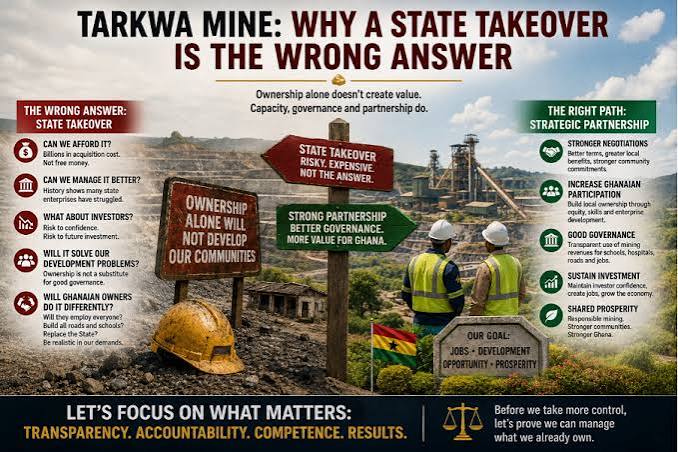
The proposal by governance and international relations expert Dr David Agbee that the Government of Ghana should assume majority ownership of the Tarkwa Gold Mine after Gold Fields’ lease expires in 2027 has understandably generated considerable public interest. At first glance, it sounds bold, patriotic and refreshingly decisive. After all, who would not want Ghana to derive more value from its gold?
But as attractive as the proposal may appear, especially to those frustrated by the slow pace of development in mining communities, a state takeover is unlikely to deliver the outcomes many expect. In fact, it risks distracting us from the real issues that have undermined development in mining communities for decades.
The frustrations are understandable. Many communities around Tarkwa still grapple with poor roads, environmental challenges, inadequate social infrastructure and youth unemployment despite decades of gold production. They deserve better.
The question, however, is whether changing the ownership of the mine will automatically solve these problems.
The first issue is affordability.
Tarkwa Mine is not a small galamsey pit with a few excavators and optimistic young men. It is one of Africa’s largest and most sophisticated gold mining operations, built through decades of investment, engineering expertise and complex operational systems. It includes processing plants, mining fleets, power infrastructure, water systems, tailings facilities and specialised technology.
Acquiring majority ownership of such an operation would require billions of dollars. The proposal suggests using the Heritage Fund, the Stabilisation Fund, sovereign bonds and concessional financing.
That should give every taxpayer pause. The Heritage Fund exists to preserve wealth for future generations, not to become an investment wallet for buying commercial assets. If we spend the children’s inheritance buying a mine, the children may one day ask why we bought the mine instead of leaving them the inheritance.
Even if Ghana could raise the money, ownership alone does not guarantee success.
Running a world-class mine requires technical expertise, disciplined management, efficient procurement and commercial decision-making insulated from political pressure. Across the world, many state-owned enterprises have struggled because commercial decisions gradually became political decisions.
There are successful state-owned mining companies, but they operate within strong institutions, robust governance systems and decades of accumulated technical capacity. Ghana must honestly ask whether it has those conditions firmly in place before assuming that changing ownership will automatically change outcomes.
Another concern is investor confidence.
For decades, Ghana has distinguished itself as one of Africa’s most attractive mining destinations because investors trust its legal framework and respect for contracts. If the message becomes, “Invest billions, develop the mine, and when the lease expires the state may take over,” investors will inevitably think twice.
Whether one calls it resource nationalism or strategic participation is beside the point. Investors make decisions based on predictability. Reduced exploration, lower foreign direct investment and higher financing costs could become unintended consequences.
Some have suggested a compromise. Rather than government operating the mine itself, they argue that it should acquire the asset and transfer it to private Ghanaian investors.
It sounds appealing. But it raises an equally important question. How differently would those Ghanaian investors operate?
Would they devote all their profits to community development instead of reinvesting in the business or rewarding shareholders? Would they employ every unemployed young person in Tarkwa? Would they build every road, school, hospital and drainage system the municipality requires? Would they assume responsibility for all the social infrastructure that government is constitutionally mandated to provide while still paying corporate taxes, royalties, PAYE, SSNIT contributions and every other statutory obligation?
If the answer is yes, then we should ask a simple question. Why has this not happened elsewhere in our economy?
Ghana has many successful indigenous businesses Zoomlion, McDan Group, Kasapreko, KGL and many others. They have created jobs, invested heavily and contributed to national development. Yet no one expects them to employ every unemployed graduate in Ghana, fix every road, build every hospital or replace government in providing public services.
Why, then, should we expect a Ghanaian-owned mining company to do what we do not expect of any other private business?
Whether a company is owned by Ghanaians, Canadians, South Africans or Australians, it remains a business. It must generate profits, reinvest in operations, remain competitive and satisfy shareholders if it is to survive. The nationality of the shareholder does not suddenly transform a mining company into a Ministry of Roads or the Ghana Education Service.
This is not an argument against greater Ghanaian participation in mining. Quite the opposite.
Ghana should continue expanding indigenous ownership, local content, supplier development and equity participation through institutions such as MIIF. But commercial ownership should never be confused with the constitutional responsibilities of government.
Perhaps the greatest weakness in the takeover proposal is the assumption that the underdevelopment of Tarkwa is primarily the responsibility of Gold Fields.
As a governance expert, Dr Agbee should know better. Roads, schools, hospitals, potable water and public infrastructure are the responsibility of the State. Mining companies exist to extract minerals within the framework established by law, pay taxes and royalties, create employment and generate returns for investors. Corporate social investment complements government development; it does not replace it.
Indeed, Gold Fields has reportedly invested more than US$100 million in its host communities through education, healthcare, enterprise development, scholarships, infrastructure and water projects. Reasonable people may debate whether that amount is sufficient.
But perhaps the more uncomfortable question is this: How much has the Government of Ghana invested in those same communities from the royalties, taxes and mineral revenues generated by the Tarkwa Mine over the same period?
Every year, mining companies contribute substantial revenues to the state through royalties, corporate taxes, PAYE, SSNIT contributions, fees and other statutory payments. A portion of these revenues is specifically intended to support development in mining communities.
Yet many of these communities continue to face serious infrastructure deficits.
Before demanding a takeover of a privately operated mine, citizens are entitled to ask how effectively those public revenues have been managed. Communities deserve transparency not only from mining companies but also from the institutions responsible for collecting and spending mineral revenues.
The uncomfortable truth is that weak development outcomes in mining communities often reflect failures of governance rather than failures of ownership.
There are better options.
Government can negotiate stronger community development commitments when the lease is renewed. It can strengthen environmental obligations, deepen local content requirements, expand Ghanaian equity participation, support indigenous suppliers and improve transparency in the management of mineral revenues.
These reforms would enable Ghana to capture greater value while preserving investor confidence and avoiding the enormous financial and operational risks associated with state ownership.
Above all, we must remain realistic.
No country is an island. Not even the world’s largest mining nations develop their mineral sectors without international capital, technology and expertise. Australia, Canada, Botswana and Chile all partner with foreign investors while ensuring that national interests are protected through strong institutions and sound policies.
Ghana should certainly build more globally competitive Ghanaian mining companies. But we should not create the impression that foreign investment is somehow incompatible with national development. It is not. In many cases, it is the very catalyst that makes large-scale mining possible.
The expiry of the Tarkwa lease is indeed an important moment. It presents an opportunity to negotiate a stronger partnership that delivers greater benefits to communities, enhances environmental stewardship and increases local participation.
What it should not become is an expensive experiment based on the mistaken belief that changing the owner of a mine will automatically solve decades of governance challenges.
The real issue facing Tarkwa is not who owns the mine. The real issue is whether the wealth generated from that mine is being managed transparently, invested wisely and translated into meaningful improvements in the lives of the people who live there.
Until we answer that question honestly, calls for a state takeover risk treating the symptom while ignoring the disease. And as every good doctor knows, treating the wrong disease can leave the patient worse off than when you started.