
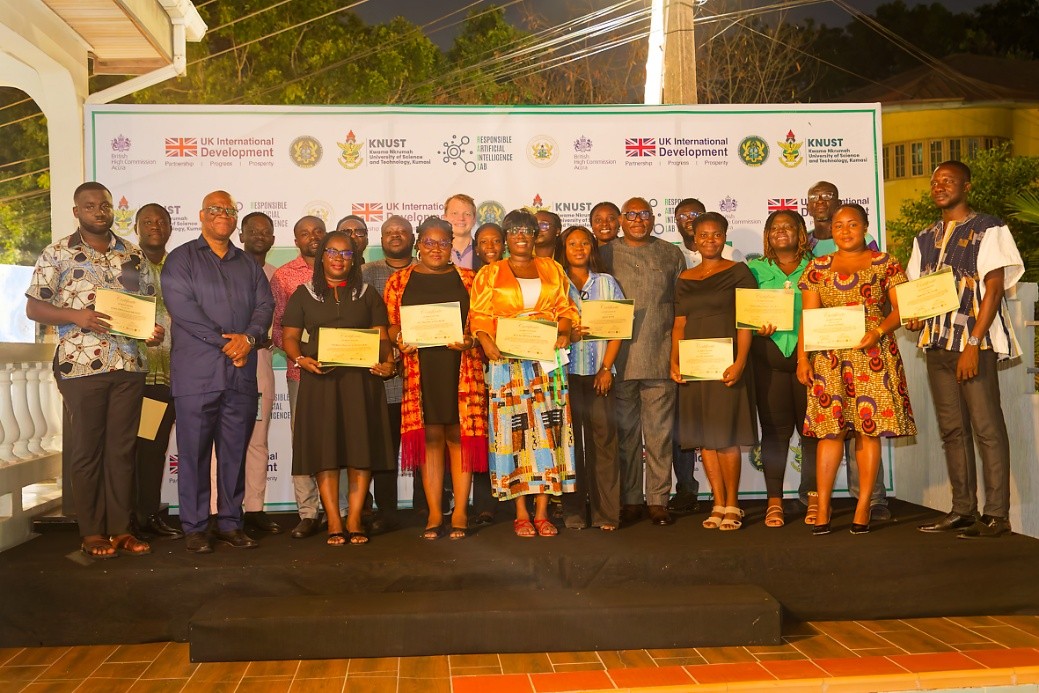
A group of participating journalists in Accra, Ghana
For many journalists, reporting on science can feel intimidating. Research papers are often dense with technical jargon, complex data, and unfamiliar processes. Yet science and technology increasingly shape how societies live, farm, innovate, and solve problems. It was with this understanding that I joined 24 fellow journalists from across Ghana for the 2026 Capacity Building for Media Excellence in Science, Technology, and Innovation (STI) Reporting training, held at the Central Hotel in Accra.
The training was organized through a partnership between Kwame Nkrumah University of Science and Technology (KNUST), the Responsible Artificial Intelligence Laboratory (RAIL), the British High Commission in Accra, and UK International Development. Over several days, we journalists sat side by side with scientists and innovation experts, exploring how the media can better communicate research breakthroughs and technological advances to the public.
Here are the 10 key lessons I learned:
- Translate complex science into everyday language
Prof. Jerry John Kponyo of the Responsible Artificial Intelligence Laboratory stressed: “We also need to be able to break it down into our local languages so that the man on the street can understand that when I apply this man’s research to my cocoa farm, my productivity will increase by this measure.”
Prof Jerry John Kponyo, RAIL KNUST
- Journalists are bridges in the knowledge ecosystem
Prof. Abigail Opoku-Mensah of the Ghana National Research Fund reminded us: “The science journalist is a bridge across that gap… You are critical infrastructure of that ecosystem.”
We are not just storytellers; we are connectors between discovery and society. - Build strong relationships with scientists
Johnson Singir from the British High Commission in Accra advised: “You can engage directly with researchers and scientists to have a feel about how the laboratory looks and what goes in when conducting research.” These connections deepen story accuracy and richness.
Mr. Johnson Singir, Science & Technology lead,
British High Commission Ghana
- Structure stories around key questions
Dr. Hephzi Tagoe of Academic City University emphasized that every story should answer: What is the discovery? Why does it matter? Who does it affect? What happens next? - Verify research credibility
Dr. Thomas Amatey Tagoe of GH Scientific warned: “Watch out for red flags such as biased language, lack of supporting evidence, or suspicious digital origins.”
Rely on peer-reviewed, well-documented studies. - Simplify without oversimplifying
Albert Ansah of the Ghana News Agency advised replacing technical jargon with relatable language and everyday examples—enough to make science understandable without distorting it. - Uphold integrity in every story
Albert Ansah also emphasized the five pillars of responsible journalism: accuracy, balance, transparency, independence, and accountability. - Understand research processes
Emmanuel Kwasi Debrah of Kwame Nkrumah University of Science and Technology explained that journalists must grasp research methods, from clinical trials to laboratory protocols, and consult multiple experts to avoid one-sided reporting. - Build trust with scientists
Many researchers hesitate to speak to journalists out of fear of misrepresentation. Establishing trust encourages them to share insights openly and confidently. - Use AI tools ethically
Thomas Amatey Tagoe noted that AI can assist reporting—but it must be used responsibly. Cross-check results across multiple tools to maintain accuracy.
The training left one message crystal clear: science journalism is more than reporting discoveries. It is about translating knowledge, building trust between scientists and society, and ensuring innovation reaches the people whose lives it is meant to improve.
The writer is a science journalist
E-mail: prissyof@yahoo.com