
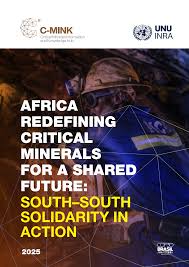
The United Nations University’s Institute for Natural Resources in Africa (UNU-INRA) has released a new report on Africa Redefining Critical Minerals For A Shared Future: South-South Solidarity in Action.
The report reflects on the unique opportunity across the Global South to turn solidarity into strategy, stressing the need for South-South collaboration to foster a new multilateralism built on shared knowledge, joint technological development, and collective investment.
The report makes the case for bringing together the collective experiences of Africa, Latin America, and Asia to co-design solutions that shift the balance of the decarbonisation agenda and scale up green value chains.
As part of UNU-INRA’s Critical Minerals Information and Knowledge Hub (C-MINK), which positions Africa at the center of global mineral governance, ensuring that the continent’s vast resources drive inclusive, green, and sustainable development, this report shows that Africa’s mineral wealth is indispensable to the global energy transition and ownership must translate into control, governance, and value creation.
The report shows that, Africa holds nearly a third of the world’s critical mineral reserves, including cobalt, lithium, manganese, and copper—resources indispensable for renewable energy technologies, electric vehicles, and digital infrastructure.
Yet, the continent has long remained at the periphery of global value chains. With reports like this, UNU-INRA’s C-MINK initiative, aims to change this long-lived reality, by curating knowledge, fostering collaboration, and enabling Africa to define its own mineral sovereignty.
By redefining “criticality”, deepening South-South solidarity, embedding justice, and strengthening governance, the report urges Africa to move from the periphery of extraction to the center of transformation.
This is important because, the global revenues from copper, nickel, cobalt, and lithium could reach $16 trillion by 2050, with Sub-Saharan Africa positioned to capture over 10% of that value.
Prof. Fatima Denton, (Director, UNU-INRA and Head of CMINK initiative) notes that, “mineral wealth must no longer be a paradox of abundance without prosperity, as Africa’s minerals are critical not only for the world’s decarbonisation agenda but for Africa’s own industrialization, energy security, and technological advancement.”
The report advocates for African expertise to be paired with that of Latin America and Asia, building South-South partnerships that prioritise shared prosperity in the critical minerals sector.
As a product of the C-MINK Initiative, the report calls for a redefined mineral order—one that prioritises justice, governance, and transformation. It argues that by embedding minerals into domestic production systems, Africa can move from being a supplier of raw materials to a driver of industrialization and innovation.
In an era of fractured geopolitics and contested green transitions, Africa’s most powerful lever lies in how quickly it can test and scale new solutions within the global South. South-South collaboration offers a “southern playbook” for resource governance that could be a strategic pivot enabling green industrialization and structural transformation.
The report advocates that Africa and the Global South should be at the center and not the periphery of the critical minerals dialogue and action. This south-south solidarity if done effectively will ensure that mineral wealth fuels a just, green, and inclusive future.