
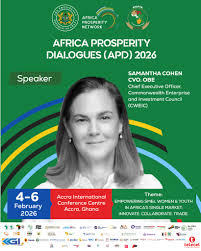
The Chief Executive Officer of the Commonwealth Enterprise and Investment Council (CWEC), Samantha Cohen CVO OBE, has highlighted the enormous economic opportunities available within the Commonwealth market, describing its combined GDP of $14.2 trillion as a major platform for trade, investment and business growth.
She made the remarks during her keynote address at the Africa Prosperity Dialogues (APD) 2026 in Accra on Wednesday, 4th February 2026. This also her first official visit to Ghana. Held under the theme ‘Empowering SMEs, Women and Youth in Africa’s Single Market: Innovate. Collaborate. Trade,’ the forum brings together African leaders, entrepreneurs, policymakers and innovators to explore strategies for deepening intra-African trade and fostering inclusive economic development.
Ms. Cohen said the Commonwealth represents one of the world’s most significant economic and demographic networks, offering vast potential for small businesses, young entrepreneurs and women-led enterprises across Africa.
She expressed gratitude to Mr. Gabby Asare Otchere-Darko, Chair of the Commonwealth Enterprise and Investment Council for Ghana and founder of the Africa Prosperity Network, for his long-standing support in advancing Africa’s economic integration agenda.
Ms. Cohen explained that CWEC, the accredited business arm of the Commonwealth, works to promote trade and investment across the bloc’s 56 member states by connecting governments, investors and businesses.
“The Commonwealth is an extraordinary institution bound together not by formal trading arrangements but by shared history, values and trusted relationships,” she noted.
She underscored the unique global reach of the Commonwealth, which is home to about 2.7 billion people, with 60 per cent of its population under the age of 30, making it one of the most youthful and dynamic economic communities in the world.
According to her, the bloc includes more than one billion middle-class consumers and comprises both some of the world’s largest economies, such as India, as well as smaller nations like Tuvalu, with all members enjoying equal voice.
Ms. Cohen stated that the cumulative GDP of Commonwealth countries stood at $14.2 trillion in 2022 and is projected to rise to $20 trillion by 2029, presenting immense opportunity if translated into tangible benefits for businesses on the ground.
However, she stressed that these headline figures must ultimately create real outcomes for small and medium-sized enterprises (SMEs), women entrepreneurs and young innovators.
“Across the Commonwealth and Africa alike, SMEs account for around 90 per cent of all businesses and more than half of all employment,” she said.
Ms. Cohen further noted that women-owned enterprises contribute an estimated $250 billion to Africa’s GDP but continue to face barriers in accessing finance, markets and networks.
She also drew attention to the rapid growth of youth-led enterprises, cautioning that many still struggle to scale beyond the informal and early-stage levels, making targeted support for seed and pre-seed businesses critical.
“These entrepreneurs are not peripheral to growth. They are the pipeline of future national champions,” she emphasised.
Ms. Cohen pointed to the Commonwealth’s strong influence in global governance, with representation on the UN Security Council, the G7 and the G20, arguing that such leverage must increasingly be used to unlock opportunities for SMEs and underserved groups.
She highlighted the growing alignment between the Commonwealth and the African Continental Free Trade Area (AfCFTA), noting that 19 AfCFTA member states are also Commonwealth countries.
“The Commonwealth and AfCFTA are natural partners in promoting open, rules-based and inclusive trade,” she said.