
“Pharmacist, I have a prescription from my local clinic. The drug was unavailable there, so I had to get it elsewhere.”
It is a familiar exchange in many pharmacies across Ghana. A patient arrives with a prescription, hoping the medicine will be in stock. Few think about the long path that medicine travelled before reaching the shelf — the repeated experiments, the waiting, the validation. Fewer still imagine how that path is beginning to change with artificial intelligence.
A Chip in Her Palm
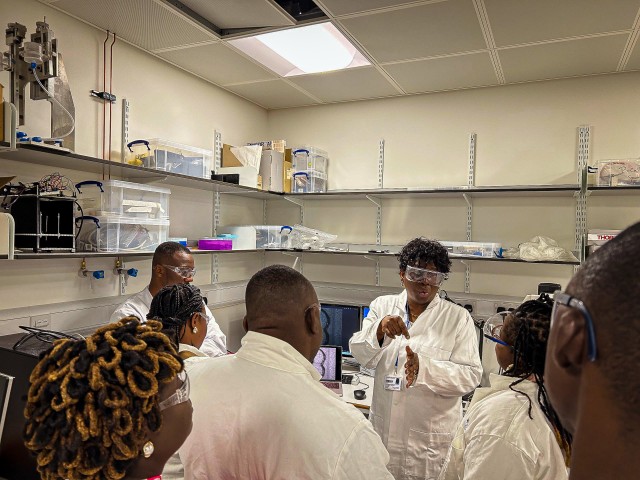
Inside the AI in pharmaceutical discovery lab at Imperial College London’s White City Campus, Dr Ofosua Klozie Adi-Dako holds out something small and transparent.
“It looks simple,” she says, passing it around, “but this is where the experiments are now.”
The object resting on her palm is a thin, clear chip. It hardly resembles a place for serious scientific work. Yet this is where she now runs tests that once demanded long hours and repeated trials.
Rethinking the Lab
Dr Adi-Dako is a lecturer at the Department of Pharmacy at the University of Ghana and a Schmidt Global Faculty Fellow. For years, she worked within the familiar rhythm of laboratory research.
“You run one experiment. If it doesn’t go well, you repeat it. Sometimes, when you are tracking what happens in certain conditions, you have to sit throughout the night to monitor it. After that, you still move to animal models to validate what you’ve done in the lab. That’s the traditional way.”
She explains that meeting research demands in a short time often requires many hands and extended periods of work.
“If you look at this critically, you may need about ten scientists working for a long time to meet the demand for results.”
The chip introduces a different pace.
She designed it herself using Autodesk software before it was laser-cut into shape from a special plastic. Within it are tiny channels where droplets measured in nanolitres and picolitres move through micro-pathways.
“With this chip, I can run many experiments at the same time, instead of doing one experiment manually and repeating it for weeks.”
Mimicking the Human Body

Inside the Drug Discovery Lab
Inside the chip, she recreates what happens in the human intestine.
“What we’re doing is mimicking what happens in the intestine. We create an artificial membrane and watch how a drug moves through it.”
Before a medicine can treat disease, it must cross body membranes for absorption. On the chip, a drug is placed on one side of a delicate barrier. She then observes how it permeates through to the other side.
“Permeability is very important. If a drug cannot pass through membranes properly, then you don’t have treatment. And if the movement is inconsistent, that affects the outcome.”
Under a microscope, the setup reveals droplets in a liquid environment, separated by an artificial layer that behaves like a membrane. This is only one well. The full chip contains many wells, each running its own test.
“The setup is able to generate over a thousand data points within a very short time. Compared to the traditional approach, this would take many months.”
Handling the chip requires precision. She has trained herself to pipette carefully so droplets do not fuse, fragment, or disturb the delicate layer between them.
Where AI comes from

Journalists Learn AI Drug Research
The large volume of data produced by the chip is analysed using artificial intelligence.
“Normally, within human capacity, we analyse data as we see it. But the AI model is able to detect anomalies and analyse patterns from different angles that I would not see traditionally. It unravels complex data patterns and gives us much more information.”
These insights guide the next stages of drug development and reduce the number of animal experiments needed for validation.
Since arriving in London in September 2025, she has trained with researchers at the I-X Center for AI in Science, working with programmers and other researchers to refine her modelling skills.
“This is a network science approach to finding solutions in healthcare,” she says. “It’s a unique opportunity to enhance my skill.”
Bringing It Home
The work is not meant to remain in London.
As part of her fellowship, she is developing a system she will carry back to Ghana. The same experiments she runs here will be possible in her lab in Accra, with continued collaboration after she returns.
“It’s going to have faster solutions. AI can predict what will happen, even with compounds you haven’t worked with before. It can also extend to the natural compounds that we have in Ghana.”
For researchers at home, this means earlier answers about which compounds are worth pursuing before entering expensive stages of testing.
She sums it up simply: “It’s cost-effective, accurate, and it brings speed.”
When she returns to the University of Ghana, the small chip will sit quietly on a lab bench. Yet it will be doing work that once required long hours, repeated trials, and many hands — producing results in days instead of months, and changing how drug research is approached.
This report is part of the UK-Ghana ST&I Media Training Programme.
The writer is a science journalist.
E-mail: prissyof@yahoo.com