
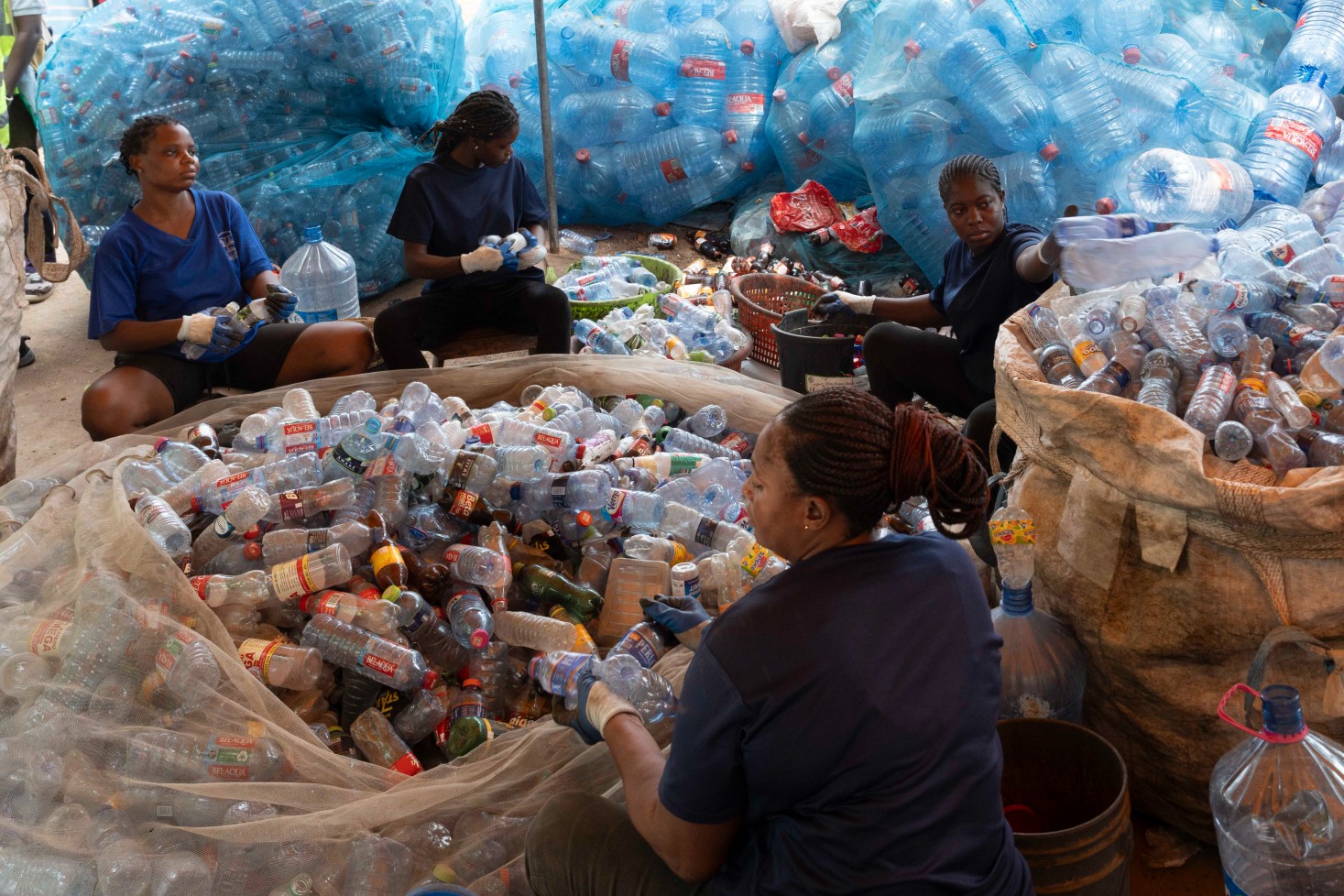
Used and discarded indiscriminately, plastics often end up in gutters, on street corners, or burning in red-lit heaps at night. But inside the Material Recovery Facility in Accra, the same plastic is handled with care. Workers bend over piles of bottles, sachets, and polythene bags, sorting them patiently by hand. What the city has rejected is being prepared for a second life.
A few kilometres away, at the CSIR-Institute of Industrial Research, that second life takes shape. Melted plastic is poured into moulds and left to cool. Minutes later, what was once waste hardens into something solid – a toilet seat, a pavement block, or an office item. The transformed product is useful, durable, and ready for use.
Dr. Francis Boateng Agyenim watches this transformation often. To him, it’s proof that plastic pollution can be outsmarted. “Once we melt the plastic, we can mold it into anything valuable,” he says.
But as he walks past shelves lined with finished products, another reality becomes clear: they are not leaving the lab.
“As a scientist, when I see what we have created, I am happy,” he admits. “But the business community asks: What is the cost? How much can we sell it for? Where are we going to sell it?” The science is working. The market is not.

Office items made from plastic waste
In another part of Ghana, Mckingtorch Africa transforms plastics into school desks, shades, and roofing tiles. Its founder, Makafui Awuku, explains another part of the problem: “Most people do not care about sustainability. They care about price. My goal is to make my roofing tiles and desk boards so cheap and close to wood in price that they become a direct substitute.”

A roof made from plastic waste
Across Borders, Similar Challenges

Washrooom built from plastic waste
The struggle to sell upcycled plastic products is not limited to Ghana.
Ecocykle, a circular economy organisation in Nigeria repurposes waste into useful solutions like plastic bottle toilets for school communities. But co-founder Aliyu Sadiq says commercialisation remains a major challenge. “A few people who are environmentally inclined are willing to pay more. But for the majority, they want what is cheap, affordable and beautiful,” he says. Even though these plastic toilets are strong and environmentally friendly, their production cost is higher than that of traditional construction methods, so people do not buy them.
A Promising Difference

A bag made from plastic
Away from West Africa, in East Africa, Uganda presents a different picture. Walakira Bruno, founder of B-MANDELA Enterprises Ltd, reports that people are interested in buying upcycled plastic products—especially reusable bags. But he notes that education is key. After explaining how these products benefit both people and the environment, interest grows. “How are they better than local ones? Such trainings help,” he says.

Most African plastic goes to waste
Across these countries, one consistent problem arises: making upcycled plastic products is often expensive. As a result, innovators must either sell at prices above what most buyers can afford or operate at a loss.
Aliyu Sadiq points out that even training women in communities to make crafts and cooking fuels from agricultural waste has not led to significant market growth because the cost of production still outweighs the price people are willing to pay.
At the same time, plastic pollution in Sub-Saharan Africa is a serious and growing concern. Scientific research estimates that the region generates around 17 million tonnes of plastic waste every year, a significant portion of which comes from everyday packaging and single-use plastics.
Much of this waste is poorly managed. Studies indicate that roughly 70 percent of all municipal solid waste in the region — including plastics — is openly dumped rather than collected and treated through formal systems. This means plastic often ends up littering streets, clogging drains, polluting rivers, and harming ecosystems.
Recycling rates in Sub-Saharan Africa remain very low compared with many other parts of the world. While precise figures vary by country and data source, international development reports suggest that only a small fraction of plastic waste — roughly 10–12 percent — is recycled, with the rest being lost to dumping or informal disposal.
Science Offers New Hope
While businesses struggle, scientists are also working on breakthroughs. One innovation comes from Imperial College London, where researchers developed a Biotransformation (Polymateria) technology. This method makes conventional plastics biodegradable. When plastics with this technology are exposed to sunlight, heat, air, and moisture, they break down into harmless substances within about two years — leaving no microplastics or toxins behind.
This technology is now being introduced in Nigeria through a partnership involving Hercules Manufacturing and Oando Clean Energy. The goal is to tackle plastic pollution from ordinary single-use plastics such as bags and water sachets.
What Comes Next?
The innovators, scientists, and communities across this continent agree on one thing: upcycled plastic products have potential — but only if they can find buyers.
Dr. Agyenim believes the next step is dialogue between scientists, businesses, and governments to determine how to make these products commercially viable.
Experts also suggest that governments and private companies should consider policies that promote locally upcycled goods — for example, by reducing the importation of products that local innovators can make from recycled plastics.
Additionally, Aliyu Sadiq insists that “Upcycling innovators do not just need applause for saving the environment — they need smart government incentives, public awareness, and practical training that make their circular products affordable, scalable, and commercially viable for the everyday consumer.”
A 2025 research study titled “Circular Economy Approaches for Plastic Waste Management in Africa: Opportunities and Challenges” highlights the economic promise of a circular economy. It notes that supporting waste collectors, recycling industries, and upcycling businesses could create jobs and reduce environmental harm — if governments provide the necessary technical and financial support.
Between Waste and Wealth
From the labs in Accra and markets in Kampala to communities in Nigeria, Africa’s innovators are finding creative uses for plastic waste. They are proving that what many call trash can become treasure — but only if the world learns to value these products.
The challenge now Is not just innovation, but commercialisation — making products that individuals and institutions will choose to buy. If that happens, this could become more than a fight against pollution; it could become a new pathway to jobs, income, and a cleaner planet.
This report is part of the UK-Ghana ST&I Media Training.
The writer is a science journalist.
E-mail: prissyof@yahoo.com