
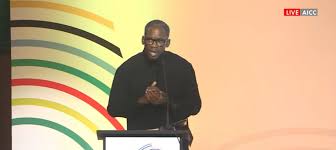
Nigerian singer-songwriter and entrepreneur Oluwatosin Oluwole Ajibade, popularly known as Mr Eazi, has called for the removal of barriers hindering movement, trade, and entrepreneurship across Africa, emphasizing that friction, not talent or ambition, is the continent’s greatest constraint.
Mr Eazi made the call at the Presidential & Business Leaders’ Dialogue, held on Day Three of the 2026 Africa Prosperity Dialogues (APD). The dialogue, held under the theme “Empowering SMEs, Women & Youth in Africa’s Single Market: Innovate. Collaborate. Trade,” took place at the Accra International Conference Centre (AICC) on Friday, 6th February, 2026.
Mr Eazi cited the challenges he faced as an artist touring the continent, recounting an experience where he was stopped at the Kenyan border despite having been paid to perform, while his band members of other nationalities were allowed entry. “This speaks to the reality of friction that stops us from uniting, from being stronger, and from developing,” he said.
Over the past four years, Mr Eazi has channeled his entrepreneurial efforts into tackling the very barriers he experienced, investing in businesses that now operate in 19 African countries and process over 4 million transactions daily. He stressed that borders, as they currently function, impede payments, regulations, and the ability of SMEs, youth, women, and creatives to scale.
“Cooperation in Africa is not new—it is natural,” Mr Eazi said, noting that Africans have collaborated across borders economically since pre-colonial times. “The young generation under 35 doesn’t care about borders. We collaborate through the Internet, business, and creativity.”
Mr Eazi emphasized that the African Continental Free Trade Area (AfCFTA) offers a historic opportunity to create a borderless Africa where trade, mobility, and business can flourish. “Much of the vision already exists. The treaties have been signed, the frameworks are in place. What remains is implementation,” he said, stressing that a connected Africa enables SMEs to grow into continental champions, women and youth to participate fully in the single market, and the continent to strengthen its global competitiveness.
On the economic potential of a unified continent, he noted that AfCFTA could bring together over 3 trillion USD in GDP, unlocking opportunities for millions of Africans. “If we make Africa borderless, Africa becomes unstoppable,” he said.
[2/6, 13:12] Asaase Radio Wilberforce Asare Dean Of Judicial Press Corp: *Tetracore Gas Ghana MD calls for borderless Africa to unlock industrial growth*
Mr. George Quansah, Executive Director and Country Director of Tetracore Gas Ghana Limited, has emphasized the critical role of cross-border integration and energy accessibility in driving Africa’s industrialization, job creation, and economic prosperity.
He made these comments at the Presidential & Business Leaders’ Dialogue, held on Day Three of the 2026 Africa Prosperity Dialogues (APD). The dialogue, held under the theme “Empowering SMEs, Women & Youth in Africa’s Single Market: Innovate. Collaborate. Trade,” took place at the Accra International Conference Centre (AICC) on Friday, 6th February, 2026.
He bemoaned the persistent barriers that hinder trade and entrepreneurship across the continent. “Africa, home to 1.5 billion people and the world’s youngest population, still finds it easier to trade with Eastern continents than with our neighbors,” he said, pointing to the cost of friction in trade, infrastructure, and regulations.
Mr. Quansah stressed that energy supply is central to Africa’s development and cannot be constrained by outdated borders. Tetracore Gas Ghana, part of an integrated energy company operating across the gas value chain, has deployed infrastructure and solutions to enable industrial growth. Across Nigeria and Ghana, the company supplies natural gas to industrial clusters, powers over 300 megawatts of generation capacity, and fuels mobile auto gas refilling stations, serving over 200 vehicles daily.
“Our mission is not just to supply gas; it is to enable industrialization, create jobs, and empower African business,” Quansah said. The company has created over 3,000 direct and indirect jobs and invested in local hiring, skills development, and community partnerships that support women, youth, and SMEs.
Mr. Quansah warned that energy and economic integration are limited when trade is constrained by borders. “Pipeline must cross borders, tracks must cross borders, investment and technology and people must cross borders. When borders slow trade, they slow energy. And when energy slows, development stops,” he said.
He called on governments, the private sector, and citizens to remove invisible barriers that limit trade and opportunity. Harmonized regulations, streamlined processes, and the free movement of goods, capital, and people, he said, are essential for Africa to fully realize the benefits of the African Continental Free Trade Area (AfCFTA).
“A borderless Africa is not political theory; it is practical economics, infrastructure, logistics, and a business necessity,” Quansah said. He urged youth, women entrepreneurs, and SMEs to take full advantage of a connected continent, noting that seamless trade, affordable energy, and unbounded ambition are key to continental prosperity.
Mr. Quansah emphasized that Africa already possesses the ingredients for growth, resources, youth, and a vast single market, but what is required now is political will, citizen momentum, and private sector leadership to ensure Africa achieves its full economic potential.