
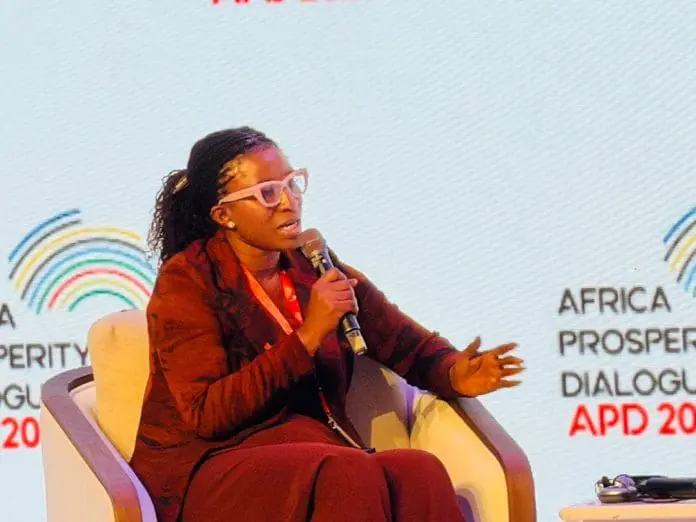
Pearl Nkrumah, Managing Director of Access Bank Ghana, called for stronger financial systems and seamless payment structures to support women-led trade under the African Continental Free Trade Area (AfCFTA). Accordingly, she emphasised that inclusive trade will only thrive if cross-border transactions are made easier and more efficient.
Nkrumah noted during a panel discussion at the 2026 Africa Prosperity Dialogue in Accra, the Ghanaian capital that unlocking capital—both within and outside Africa—depends largely on whether countries create enabling environments that allow investments and financing to flow smoothly into local economies.
She explained that while Ghana and other African states are already pursuing blended financing arrangements and strategic partnerships with external partners, the real priority must be ensuring that financing directly supports productive trade activities, especially for women entrepreneurs operating across borders.
“For women trading among ourselves, the key question is how do we enable platforms that make it smooth and fluid for a woman in Ghana to ship products to other countries and receive payment back seamlessly,” she said.
Madam Nkrumah highlighted that women-owned businesses require not only access to capital but also functional trade ecosystems—marketplaces, procurement networks, and payment channels—that allow them to move from small enterprises into larger suppliers and regional trade partners.
*Stronger AfCFTA support for women traders*
Nana Oye Bampoe Addo, Deputy Chief of Staff for Administration at the Office of the President of Ghana, called for strategic and well-resourced implementation of the African Continental Free Trade Area (AfCFTA) protocols to ensure women engaged in informal cross-border trade fully benefit from the agreement.
She noted that women account for nearly 70 percent of informal cross-border trade across the continent, making them indispensable to Africa’s trade and economic integration agenda.
Drawing from a personal experience during a visit to The Gambia in March last year, she recounted witnessing salted fish being purchased and packed into trucks for transport back to Mankessim in Ghana’s Central Region.
“How does AfCFTA provide opportunities to expand that trade? How does it create an enabling environment for payments and smooth cross-border movement?” she asked, stressing the need for policies that reflect the realities of informal traders.
Nana Oye expressed concern about persistent trade barriers, including challenges in moving goods even between neighbouring countries such as Ghana and Côte d’Ivoire. She argued that such obstacles highlight the urgency for governments, particularly trade ministries, to work in synergy to make AfCFTA’s objectives achievable. “This means that whatever we do in implementing AfCFTA and the protocols must be strategic and deliberate,” she said.
*African diaspora wealth*
Prof. Marie-Line Sephocle, Founder of the Women Ambassadors Foundation and the Women Ambassadors Conference, highlighted the significant economic and educational potential of the African diaspora in the Americas. She urged Africa leaders to engage strategically with these communities to drive trade, investment, and development.
Prof. Sephocle emphasized that the African diaspora across the Americas, spanning 35 countries, represents not only a resilient population with a shared history but also a source of wealth, institutional knowledge, and networks that African countries can leverage.
“Within the United States alone, there are 30 thriving African American-owned banks and 105 African American universities,” she noted. “These institutions, alongside chambers of commerce and other organizations across countries like Colombia, represent untapped opportunities for partnerships and investment in Africa.”
Prof. Sephocle cited Howard University, an iconic African American institution, as an example of the educational and social capital embedded within the diaspora. She stressed that African nations must recognize and strategically connect with these institutions to harness their potential in advancing the continent’s economic agenda.
“Engaging the diaspora is not just about capital—it’s about knowledge, networks, and influence that can accelerate Africa’s trade and development objectives,” Prof. Sephocle said further.